Published
Feb 23, 2026
Author
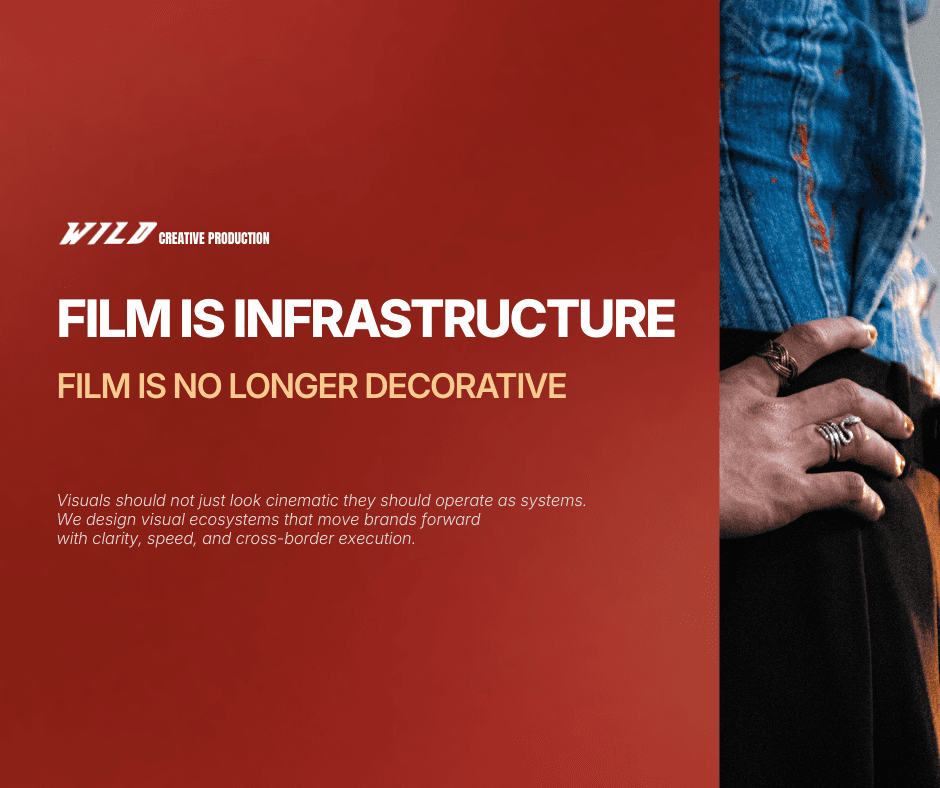
Film Is Infrastructure, Not Decoration
Film Is Infrastructure, Not Decoration
Over the past decade, video has become one of the most accessible tools in brand communication. Cameras are lighter, editing software is faster, and distribution happens instantly across platforms. Yet despite this accessibility, many brands still approach content in a fragmented way. A campaign requires a video, a launch requires a reel, and social media requires short clips to maintain visibility. Production increases, but continuity rarely follows.
This is often because film is treated as output rather than as structure. It is seen as something to produce when needed, rather than something to design intentionally. The result is reactive content: visually appealing, sometimes even viral, but disconnected from a broader system. Without structure, content becomes temporary. It fills a moment, but it does not build momentum.
When film is treated as infrastructure, the logic changes. Instead of asking what to post next week, brands begin to ask what system they are constructing. Infrastructure defines consistency across tone, rhythm, composition, and narrative. It ensures that visual language does not fluctuate with each project, but instead accumulates meaning over time. A single production can generate modular assets, adaptable across channels without diluting identity.
Infrastructure also shapes velocity. When production workflows are designed intentionally—from pre-production planning to post-production sequencing—content becomes predictable without becoming repetitive. It moves across teams and time zones with stability, reducing dependency on last-minute urgency. In this model, film is no longer decorative. It becomes operational.
Decoration fades with trends. Infrastructure endures through them. Brands that recognize this distinction stop chasing isolated moments of attention and begin constructing visual ecosystems. Ecosystems create coherence, coherence builds trust, and trust allows scale.
Film, when structured correctly, is not merely a visual asset. It is a framework that supports long-term brand clarity. And clarity, more than noise, is what sustains relevance.
Over the past decade, video has become one of the most accessible tools in brand communication. Cameras are lighter, editing software is faster, and distribution happens instantly across platforms. Yet despite this accessibility, many brands still approach content in a fragmented way. A campaign requires a video, a launch requires a reel, and social media requires short clips to maintain visibility. Production increases, but continuity rarely follows.
This is often because film is treated as output rather than as structure. It is seen as something to produce when needed, rather than something to design intentionally. The result is reactive content: visually appealing, sometimes even viral, but disconnected from a broader system. Without structure, content becomes temporary. It fills a moment, but it does not build momentum.
When film is treated as infrastructure, the logic changes. Instead of asking what to post next week, brands begin to ask what system they are constructing. Infrastructure defines consistency across tone, rhythm, composition, and narrative. It ensures that visual language does not fluctuate with each project, but instead accumulates meaning over time. A single production can generate modular assets, adaptable across channels without diluting identity.
Infrastructure also shapes velocity. When production workflows are designed intentionally—from pre-production planning to post-production sequencing—content becomes predictable without becoming repetitive. It moves across teams and time zones with stability, reducing dependency on last-minute urgency. In this model, film is no longer decorative. It becomes operational.
Decoration fades with trends. Infrastructure endures through them. Brands that recognize this distinction stop chasing isolated moments of attention and begin constructing visual ecosystems. Ecosystems create coherence, coherence builds trust, and trust allows scale.
Film, when structured correctly, is not merely a visual asset. It is a framework that supports long-term brand clarity. And clarity, more than noise, is what sustains relevance.
Next Blog
Next Blog